
Adventures in disassembly
I had a pile of dead vapes, a hot air station I barely knew how to use, and no components yet. One of them came apart into a practice board, a screw I did not see, and a microphone I probably killed.
I have been waiting on parts for the surface mount projects, and there is a pile of dead vapes on my bench. I had it in my head that I could warm one on the hot plate to soften the adhesive and get it open easier. So I asked Claude what it thought of that.
It told me not to. A reflow plate runs somewhere around 130 to 250C. A lithium cell starts coming apart well inside that range, and past about 150C it will keep going on its own without any help from the plate. So the plan was to take an unprotected cell with a history I know nothing about and press it against a heat source, straight through the window where it fails. I was thinking about the glue. The cell had never crossed my mind.
So I opened one by hand. Pried at the seam, got the shell to part, and then could not work out what was holding the board in. I asked whether I should just cut it out. The answer was to find the retention first, and when I turned the thing over, the foam pad on the bottom was covering a screw. Doh.
What is in one of these
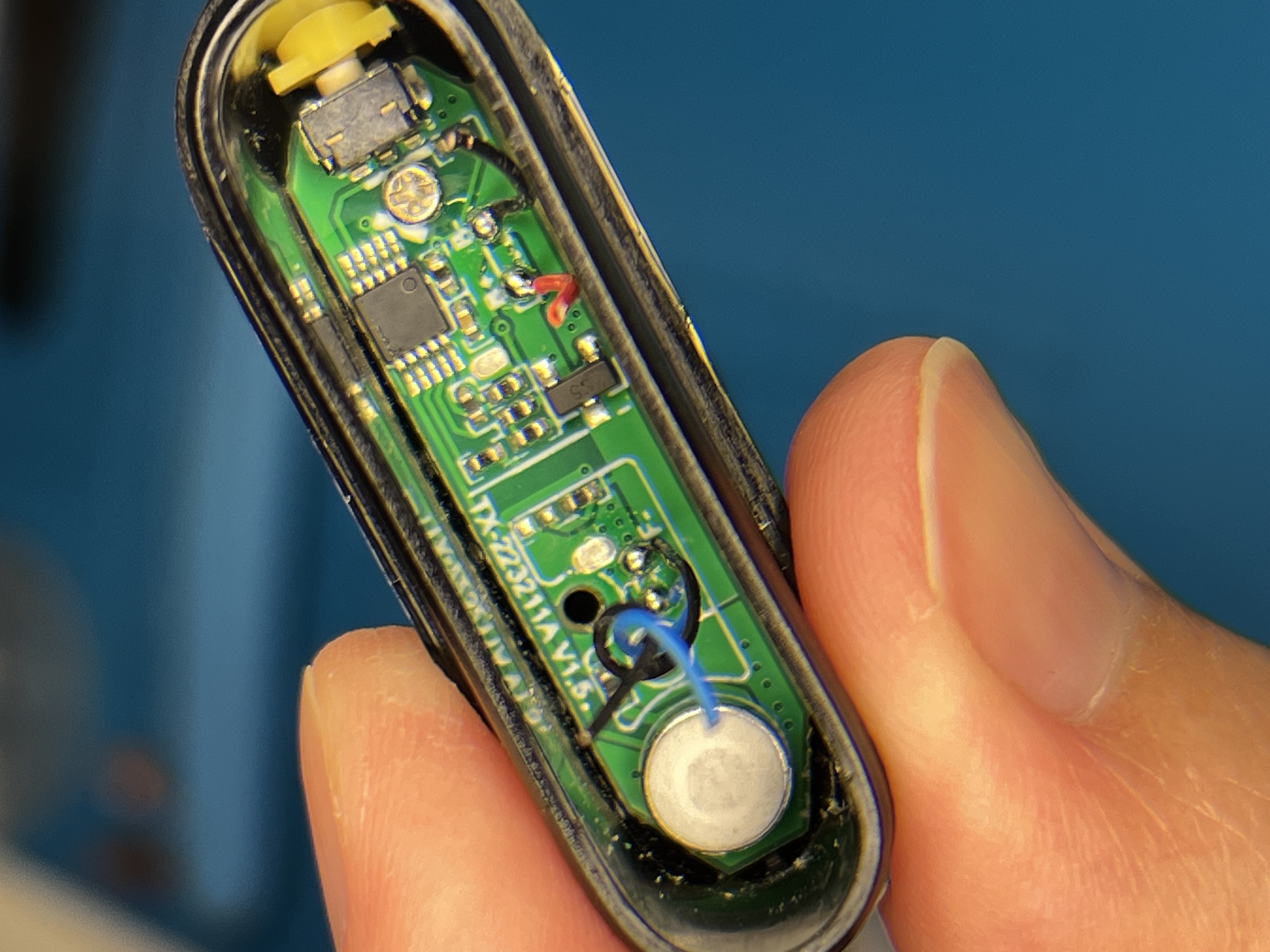
More than I expected. A pouch cell with its own small protection board on the end of it. A USB-C receptacle. A controller. A spring loaded gold pin where the pod drops in, which is the sort of contact that is genuinely annoying to buy in ones and twos. And a small white disc at one end, wired with two fine leads instead of being placed like everything else on the board.
I wondered out loud whether the white disc was the draw sensor, because there is a lil hole through the board right underneath it. That was right. It is an electret microphone. The way one of these knows you are pulling on it is that air moving past the port makes noise, the mic hears the noise, and above some threshold the controller fires the coil. There is no pressure sensor anywhere in it. I have been thinking about that one on and off since.
The practice
That is what I actually wanted these for. I have a soldering iron, a hot air station and a hot plate, and so far I have mostly used the iron. A vape board is small and dense, it has a decent spread of packages on it, and I do not care even slightly if I cook a pad.
I also had to ask what half of them were called. 0402, QFN, SOT-23. They are package names, so they describe the body and how it attaches rather than what the part does, and the reason it matters is that the package is what decides how you get it off.
The mic had to come off first, with the iron, because it is the one part on there that will not survive being reflowed. That is the part that beat me. It stuck with the pins still down in the holes, and then the solder stopped melting no matter how long I held the tip on it. I kept going at it well past the point where I should have stopped. I think I probably killed it.
The rest came off clean. The SOT-23 first as a warmup, then the QFN, then the USB-C, which was the stubborn one because it has mechanical legs down into plated holes as well as the signal pins. Board is stripped. The pads still look gold and defined, with some darkening around the mic.
There are more in the pile. Putting parts back down is supposed to be the harder half, and I have not tried that yet.
all bench notes